Friday, April 14, 2006

woe-illumed rabbit holes

there's a lot swirling around in here. let's say it began yesterday morning when i was riding the bus and i had a thought about motherhood. real motherhood, and possibly my first real thought about motherhood as creation. i simply thought what if i am on my deathbed and i find myself regretting that i've left nothing behind? assuming i never produce anything real and lasting in the way of art, and assuming i never end up going through with the "easiest" creation of another life, will i sit at the threshhold between here and something else and find myself feeling remorse at having left nothing behind to remember me by? i know this is a common fear and a common reason people choose to have children. i'm not sure it is a concern of mine now in the common way, i am just wondering how it would feel to get to the point of no return and realize something you never knew you wanted has been left undone.


it continued when, last night, i went out for drinks and meaningful conversation with two older women. amazing, smart, accomplished, childless and currently single older women. conversations such as this always leave me feeling affirmed and fearful of my future. [an aside: have you ever had those moments where you feel like some sort of deep transformation was supposed to have taken place but the routines of your life sink in before anything seems to change?] during the conversation, i blurted out how i needed always in my life to have at least one arena where i was able to hold onto my ideals and my romantic allusions or i would resort to heavy substance abuse. they pushed my martini glass away from me. i laughed but i think i was speaking the truth. when every ounce of my innocence or faith is squelched, i think something bad may happen. innocence and faith are thoughtfully vague and interchangeable words.

by stealing the image directly above i have justified the consumption of my first born child.
all of the images in today's blog post were arrived at by image-searching on the word "unadulterated". i've been chewing on that word since i used it in a poem yesterday.
SYLLABICATION: a·dul·ter·ate
TRANSITIVE VERB:Inflected forms: a·dul·ter·at·ed, a·duter·at·ing, a·dul·ter·ates
To make impure by adding extraneous, improper, or inferior ingredients.
ADJECTIVE:Spurious; adulterated. 2. Adulterous.
ETYMOLOGY: Latin adulterre, adultert-, to pollute
i suppose this all means i don't want to entirely grow up. i was also very adult as a young child. now i'm thinking about all my life being about meeting somewhere in the middle, and this rings some bell in my head. a bell that is tied to a string which seemingly, in my mind, has a ribbon of text re-minding me of Alice in Wonderland. so off to google i have gone, and here's what i've found:
"Food: Food is the used in this novel as a metaphor for growth. Carroll is literalizing the old notion that food helps you grow big and strong, that food is the path to adulthood. Ironically, Carroll is also pointing out that growing up is only half the way to adulthood. Alice can control her size and therefore her position as an adult with the food provided by the Caterpillar, but it isn't until the Cheshire Cat shows her the dangers of adulthood that she is able to be truly adult. Food can make you big in Wonderland (as in life) but only mercy and experience can make you wise.

Red: Red is the symbol of adulthood (literally it can be taken to refer to menstrual blood, and thus fertility and vigor). The Queen and Alice are on opposite sides of this color, Alice just growing into her adulthood, the Queen just growing past it. It is over this place, this wise middle ground, that the novel fights. Red is, hopefully, a place (or an age) of balance between rules and mercy, between young and old, between wisdom and nonsense."
there's an article about Alice and Wonderland and the Shroud of Turin that also appeared in my results. it is Easter weekend. happy easter if it is a happy time for you.

Sunday, April 09, 2006

milking (more)

my fingers smell of softly souring milk as i begin this post. only mildly strange as i did take my coffee with cream this morning and i've not had cause to wash my hands since. but fitting and not unpleasant.

as i'm wont to do, i've been thinking about boys and men.

so much so i stumbled today onto a most absurd party idea and have invited some blokes i think i like quite a lot, but not per se in that way, to a sausage fest. yes i called it a Sausage Fest in the invitation, and i referenced Kubla Khan (another thing you may know i am quite wont to do). so i've offered to grill bratwurst for 8 men and ply them with beer. i've asked them to bring a film along that, in their opinion, best encapsulates "the plight of masculinity". discussion is optional. while on some level i see how this appears to be a gang-bang waiting to happen or an exploration of latent homosexuality. it isn't in the least. i think this speaks volumes about the men i have invited and the height of my regard. i won't, however, be nonplussed if nobody decides to attend.

what could or should be surprising, but isn't--perhaps because i'm the type of person who searches on the word "nonplussed" when she is writing about sausage fests (go back and follow)--is that while writing this post today somebody i don't know well is simultaneously telling me about his sex life of late which includes recent encounters with a woman he doesn't know well and the routine is that he arrives at her home, simulated breast-feeding occurs for an extended period of time and then mommy has sex with her little boy. i'm not stricken by this story, nor can i hope to explain how this conversation i'm having isn't charged or dirty to me. i'm just struck by the synchronicity of my current thoughts on a metaphorical level and another person's concrete admission. reality is a strange thing. i'm also reflective on how i prompt these stories from other people, men i mean. the stories from women always seem to flow out of our conversations and the depth of our relationship more organically.

during this reflection, i've so far paused on this essay:

Four Loves, No Loves:
The Four Greek Loves in Ulysses


"Amor vincit omnia" writes Virgil in his Odyssey-esque Aeneid -- "Love conquers all." James Joyce remained conscious of his classical heritage during Ulysses' seven-year composition, drawing on sources from Homer to Dante to Thomas Aquinas to Shakespeare, and love was naturally one of his topics. Greek has words for four kinds of love: agape, or spiritual love; storge, or familial love; the love between friends, or philia; and sexual love, the familiar eros.

All four figure in Joyce's massive novel, gamboling about in his tapestry of words, yet all eventually evade the two male protagonists, Stephen Dedalus and Leopold Bloom: Ulysses proves ultimately to be a love-less work.

Agape -- spiritual love, the charitable love among coreligionists or between Man and God -- seems sure to appear, given Ulysses' protagonists' backgrounds and the host of Christian symbols that flock about them. Yet Stephen Dedalus is torn with doubt in his Catholicism, and we find in the course of the novel that Bloom renounced his Judaism, first to convert to Protestantism with his father and then, conveniently, to convert to Catholicism to marry Molly: both have fallen from their original faith. Within two paragraphs of Ulysses' opening we see a mock Mass -- "Introibo ad altare Dei" (p. 3) -- and hear the lurking Stephen scornfully called a "fearful jesuit" by mocking Mulligan. Stephen is certainly no recipient of agape here! Interestingly, Simon Dedalus identifies Mulligan as Stephen's "fidus Achates" (p. 73), a glancing Virgil image to set Stephen up as "pius Aeneas", "pious Aeneas", Virgil's hero of proper behavior to gods and men. But, as we see, home-stealing, ever-jeering Mulligan is no more "fidus" than whoring, drunken Stephen is "pius".

Stephen Dedalus is a prolix speaker, an engaging theorist and theologian, well versed in ecclesiastical history, particularly in the Church's early heresies. Yet, for all his knowledge and cogent arguments, he shows little inclination for belief. His arguments on Shakespeare's Hamlet are innovative, but he freely and "promptly" (p. 175) admits that he does not believe them -- what, then of equally intricate Catholic doctrine? Is it also only a tissue of lies, good for nothing but entertaining arguments? "You behold in me... a horrible example of free thought." (p. 17) Stephen sees only "the playwright who wrote the folio of this world and wrote it badly... hangman god... [who] would be bawd and cuckold." (p. 175) Trapped in such cynicism, Stephen feels charitable impulses towards his destitute sister Dilly ("Save her," (p. 200)), but holds back to guard himself instead ("She will drown me with her," (ibid)): again he rejects agape. In the climactic "Circe" scene in the brothel, Stephen becomes a perverted Cardinal Dedalus, attended by the seven "cardinal" sins and wearing a rosary on corks and a corkscrew cross -- distorted faith and agape again.

Leopold Bloom seems more gifted with agape� than his younger companion, but even he seems never to fully realize his charitable impulses. Bloom's mind turns all his philanthropic impulses into practical commercialism. His help to the blind stripling crossing the street (p. 148) is filled with critical examinations ("Stains on his coat. Slobbers his food, I suppose...." etc. (p. 148)) and followed by one of Bloom's pseudophilosophical musings, this time, of course, on blindness. Similarly, the sight of Dilly Dedalus outside Dillon's auctionrooms (p. 124) prompts some pity -- "Good Lord, that poor child's dress is in flitters." -- but no action aside from ruminations on Catholicism and contraception. Even Bloom's early-morning care of Stephen receives rationalization: it is all for "intellectual stimulation," the possibility of making money by writing an article, or opportunities to exploit Stephen's literary and musical talents on Molly's tours. Even Bloom's social agenda, as explained to Stephen over early morning coffee (p. 526), is to "see everyone... having a comfortable tidysized income...." -- with no hint of how to achieve it. Again, we see empty charity, thought without action -- lack of agape.

Familial love, or storge, receives similarly short shrift in Joyce's novel. Stephen describes his parents as "the man with my voice and my eyes and a ghostwoman with ashes on her breath. They clapped and sundered, did the coupler's will" (p. 32) -- hardly a flattering picture. Stephen passes by his cousins' cottage during his walk on the beach, dismissing it and his parents' home as "houses of decay" (p. 33). And even among his first recollections of Paris, Stephen mentions that "Belluomo rises from the bed of his wife's lover's wife" (p. 35), a complicated perversion of normal family structure and relationships which mirrors Stephen's own unhappy thoughts. Throughout Ulysses, Stephen is tormented by the thought of his mother as "beastly dead," in part because he disobeyed her last wishes by not praying at her bedside. At last, amidst Circean revelry and hallucination, Stephen's father calls a foxhunt after his son, and his mother appears to torment him to the Luciferian exclamation "Non serviam!" -- "I shall not serve!" (p. 475)

Bloom, too, undergoes both memories of and hallucinatory reunions with his parents. Bloom's father committed suicide, a grim rejection of the family and of storge, and Bloom's son Rudy died in infancy -- his family has been cut off at both ends. Only wife Molly and daughter Milly remain, but they are both distant: Bloom has not had sex with his wife since Rudy died, and Milly lives away from home, only writing the occasional hurried letter. Bloom's parents reappear, however, to rescold him for a childhood accident (p. 358), and his grandfather Lipoti Virag "chutes rapidly down the chimneyflue" in the brothel to discourse scientifically and pedantically on sex, then to acquire a parrotbeak, turkey wattles, a "glowworm's nose," wings, and more: a horrid and unpredictable sequence. Even Bloom's locked drawers, home of his "Henry Flower" letters and legal documents, prompts unpleasant memories of his father's age and decline. Admittedly, Bloom's son Rudy appears, idealized and presented as he might have been had he lived (p. 497), and seems to link Bloom and Stephen in a father-son relation of sorts -- but Bloom's commercial mind drives out all possibility of storge� or charitable agape.

Philia, or the love between friends, is less common in Ulysses' Ireland than one would hope -- at least for Stephen and Bloom. Bloom is an outsider, and constantly made to feel it, from the newspaper office of "Aeolus" to the pub of "The Cyclops" -- in both places he is excluded, ignored or insulted. Even in "Oxen of the Sun," the narrator asks "with what fitness... has this alien... constituted himself the lord paramount of our internal polity?" (p. 334) when Bloom merely wonders over the medical students' immaturity. Even Bloom's attempts to give philia are met with a cold rebuff, such as Menton's stony coldness when Bloom points out the dinge in his hat (p. 95). And Bloom seems not to be the only one lacking friendly treatment -- Stephen is teased and ridiculed by housemates (Mulligan) and medical students (Lynch puts the boastful poet in his place, asking for "something more, and greatly more, than a capful of light odes" (p. 339), and the others attack Stephen's "perverted transcendentalism" (p. 341)).

Indeed, the world of Ulysses as well as its main characters seem bereft of philia. The intense political discussions in the newspaper office and bar show not so much a love of Ireland as a hatred of England: a love of violent battles and martyrs, hatred and killing. Bloom tries to explain: "Force, hatred, history, all that. That's not life for men and women, insult and hatred. And everybody knows that it's the very opposite of that that is really life.... Love.... I mean the opposite of hatred." (p. 273) But he is mocked and derided by the others in the bar, even to the point of barely escaping from some violent ruffians led by the bigoted Citizen. The men of Ulysses have little agape, and Bloom sees women as scarcely better off: after masturbating on the beach, he muses on them "Picking holes in each other's appearance. You're looking splendid. Sister souls. Showing their teeth at one another. How many have you got left? Wouldn't lend each other a pinch of salt." (p. 302)

Bloom does eventually imagine a world where he is recognized and loved, in his grand hallucination of "the new Bloomusalem in the Nova Hibernia of the future" (p. 395), ushering in the "Paradisiacal Era" (p. 397). But it is, after all, a fantasy, little different from his masturbation on the beach. The first act of "the world's greatest reformer" (p. 392), the self-contradictory "emperor-president and king-chairman" (p. 393), is, Caligula-like, to "nominate our faithful charger Copula Felix ["good screw"?] hereditary Grand Vizier," then to repudiate Molly and take to wife "Selene, the splendour of night" (p. 394). There follows the most frenetic string of promises and reforms, a literal attempt to be all things to all people regardless of contradiction, all too clearly summed up in his "free money, free rent, free love and a free lay church in a free lay state" (p. 399). So starved is Bloom for care and affection that he weaves into his falsehoods even a pregnancy for himself, bearing eight successful sons. But so accustomed is he to rejection that his dream comes around to that at last, and he is martyred, burned at the stake.

Last but far from least, Joyce weaves eros, or erotic love, into his tale. As with his dreams of Bloomusalem, Bloom's fantasies of eros are idealized and unfulfilled. He has not had sexual intercourse with his wife Molly for ten years, since the death of their infant son Rudy. He carries on an almost-erotic correspondence with Martha Clifford, but takes pains to keep her at a distance, unresolved and idealized. He masturbates to Gerty MacDowell on the beach when she lets him see her underwear, but that, too, is imperfect eros, not communal but casual, a still-distant, imaginary act more in the imagination than the physical, real world. Like the temperance service in the nearby church with its mere display of the communion, it is mere appearances, not the act itself. Fittingly enough, when Bloom's alter-ego Henry Flower takes shape in the "Circe" episode, he makes love to a severed female head: an unbodied, eros-less relationship.

Erosalso appears in Bloom's fantasies, but always as perversions or prettified past events. Josie Powell (now Mrs. Breen), one of Bloom's early romances, appears in his dreams in the slum street, and chuckles "You were always a favorite with the ladies" (p. 363). But when the Nymph of his bedroom picture interrogates Bloom about his sex life, he complains of his youth that "no girl would when I went girling. Too ugly. They wouldn't play...." (p. 448). Which should we believe? The latter seems more likely. Mrs. Breen implies several romantic encounters with young Bloom, but on the verge of a more informative, definite part of the story ("you asked me if I ever heard or read or knew or came across...." (p. 367)), she fades from Bloom's dream with nothing but a tantalizing series of "yes"'s: the reader is left as unfulfilled as Bloom. In Bloom's imagined trial, his former scullery-maid Mary Driscoll comes to accuse him of "a certain [lewd] suggestion" (p. 376), but again it appears that nothing happened between them. As if to underscore Bloom's separation from eros, when the whore Zoe tries to fondle his testicles she grabs his potato talisman instead, and her request for a "swaggerroot" sends Bloom off onto an anti-smoking diatribe, hardly a fit conversation for a hopeful bed-partner.

Bloom's entire sexual identity seems warped, at least by the standards of Joyce's period. Several ladies of polite society materialize during his imagined trial to accuse him of sending them "improper letters" (p. 381) praising their underwear, offering to mail them erotica, and asking to be horsewhipped. When one of the dream-figures offers to fulfill the final request, Bloom "quails expectantly" (ibid) in eager anticipation -- not of a sexual encounter, but of a pseudo-erotic beating. Similarly, a Circean Bloom-dream metamorphoses the whorehouse madame into masculine Bello and Bloom into a submissive female to be beaten and ridden, and Bloom recalls lounging in bed wearing second-hand womens' undergarments, fantasizing over being ravished. When Bloom at last returns home, Molly complains to herself of her husband "never embracing me except... the wrong end of me... any man thatd kiss a womans bottom Id throw my hat at him" (p. 639), yet that is exactly what Bloom does -- kiss her buttocks, the most anonymous and androgynous part of her body.

In fact, Molly's final thoughts in Ulysses only underscore the lack of eros which has afflicted Bloom throughout the book. She begins to menstruate ("this bloody pest of a thing" (p. 642)) even as she considers trying to re-establish sexual relations, and moves in her thoughts to their tryst on Howth Hill -- the same rendezvous Bloom has recalled so fondly before. Yet, like all too many of the happy occasions in Ulysses, this one is in the past, dead and gone. Indeed, the book ends in Molly's "yes I said yes I will Yes." (p. 644), but the "Yes" is in the past, only another sad comment on Bloom's lack of love. Love is a thing of the past, dreams are sick counterfeits and cheats: agape, storge, philia, eros, the four loves, are forlorn.

emphasis added by me and written by, i think, joseph lockett
it's an honest mistake, made often enough, to think that someone that ponders men and boys as often as i do, and speaks so often what she thinks...well to think that i might hate them. i don't think this is true. i remain hopeful that it isn't, as i keep writing with my milky fingers which while a bit sour still mainly smell sweet. yes I said yes I will Yes.

Sunday, April 02, 2006

boy, oh boy

i wish i could quit articles that reference contemporary films, but gee i suppose these films are supposed to reflect on the times. and, well, i've been reflecting on the times. failure to launch...please check out the forthcoming plog post about sex. yes, sex. so don't read it if you're faint of heart or under the age of 4.

What's Happening to Boys?

Young Women These Days Are Driven -- but Guys Lack Direction

By Leonard Sax
Friday, March 31, 2006; Page A19

The romantic comedy "Failure to Launch," which opened as the No. 1 movie in the nation this month, has substantially exceeded pre-launch predictions, taking in more than $64 million in its first three weeks.

Matthew McConaughey plays a young man who is affable, intelligent, good-looking -- and completely unmotivated. He's still living at home and seems to have no ambitions beyond playing video games, hanging out with his buddies (two young men who are also still living with their parents) and having sex. In desperation, his parents hire a professional motivation consultant, played by Sarah Jessica Parker, who pretends to fall in love with McConaughey's character in the hope that a romantic relationship will motivate him to move out of his parents' home and get a life.


The movie has received mixed reviews, though The Post's Stephen Hunter praised it as "the best comedy since I don't know when." But putting aside the movie's artistic merits or lack thereof, I was struck by how well its central idea resonates with what I'm seeing in my office with greater and greater frequency. Justin goes off to college for a year or two, wastes thousands of dollars of his parents' money, then gets bored and comes home to take up residence in his old room, the same bedroom where he lived when he was in high school. Now he's working 16 hours a week at Kinko's or part time at Starbucks.

His parents are pulling their hair out. "For God's sake, Justin, you're 26 years old. You're not in school. You don't have a career. You don't even have a girlfriend. What's the plan? When are you going to get a life?"

"What's the problem?" Justin asks. "I haven't gotten arrested for anything, I haven't asked you guys for money. Why can't you just chill?"

This phenomenon cuts across all demographics. You'll find it in families both rich and poor; black, white, Asian and Hispanic; urban, suburban and rural. According to the Census Bureau, fully one-third of young men ages 22 to 34 are still living at home with their parents -- a roughly 100 percent increase in the past 20 years. No such change has occurred with regard to young women. Why?

My friend and colleague Judy Kleinfeld, a professor at the University of Alaska, has spent many years studying this growing phenomenon. She points out that many young women are living at home nowadays as well. But those young women usually have a definite plan. They're working toward a college degree, or they're saving money to open their own business. And when you come back three or four years later, you'll find that in most cases those young women have achieved their goal, or something like it. They've earned that degree. They've opened their business.

But not the boys. "The girls are driven; the boys have no direction," is the way Kleinfeld summarizes her findings. Kleinfeld is organizing a national Boys Project, with a board composed of leading researchers and writers such as Sandra Stotsky, Michael Thompson and Richard Whitmire, to figure out what's going wrong with boys. The project is only a few weeks old, it has called no news conferences and its Web site ( http://www.boysproject.net ) has just been launched.

So far we've just been asking one another the question: What's happening to boys? We've batted around lots of ideas. Maybe the problem has to do with the way the school curriculum has changed. Maybe it has to do with environmental toxins that affect boys differently than girls (not as crazy an idea as it sounds). Maybe it has to do with changes in the workforce, with fewer blue-collar jobs and more emphasis on the service industry. Maybe it's some combination of all of the above, or other factors we haven't yet identified.

In Ayn Rand's humorless apocalyptic novel "Atlas Shrugged," the central characters ask: What would happen if someone turned off the motor that drives the world? We may be living in such a time, a time when the motor that drives the world is running down or stuck in neutral -- but only for boys.

Leonard Sax, a family physician and psychologist in Montgomery County, is the author of "Boys Adrift: What's Really Behind the Growing Epidemic of Unmotivated Boys," to be published next year.

Saturday, March 11, 2006

thrums


σειρήτια - that's greek


1. I am come into my garden, my sister, my spouse: I have gathered my myrrh with my spice; I have eaten my honeycomb with my honey; I have drunk my wine with my milk: eat, O friends; drink, yea, drink your fill, O beloved.
2. I sleep, but my heart waketh: it is the voice of my beloved that knocketh, saying, Open to me, my sister, my love, my dove, my undefiled: for my head is filled with dew, and my locks with the drops of the night.
3. I have put off my coat; how shall I put it on? I have washed my feet; how shall I defile them?
4. My beloved put in his hand by the hole of the door, and my bowels were moved for him.
5. I rose up to open to my beloved; and my hands dripped with myrrh, and my fingers with sweet smelling myrrh, upon the handles of the lock.
6. I opened to my beloved; but my beloved had withdrawn himself, and was gone: my soul failed when he spake: I sought him, but I could not find him; I called him, but he gave me no answer.
[song of solomon, chapter 5, snip]


there is more to come.

Wednesday, March 01, 2006

path of least existence

I just had that phrase pop into my head earlier this morning. On a somewhat related and certainly topical note:

Decoding 'Brokeback'

Why women get it and men don't go

By Brendan Tapley. Brendan Tapley is writing a memoir on masculinity. His work has appeared in The New York Times and Carolina Quarterly
Published February 26, 2006

WOMEN AS THE WEAKER SEX? Not at the 3:40. Definitely not at the 7:15. And, by a good margin, not at the 5:30 or 8:30 shows either. This is how many times I've seen "Brokeback Mountain," and each time I've checked out the crowd. The audience for the film-a film about men and masculinity, a film that can be hard on women-is curiously female. As the pre-show begins, they are still coming-often five-wide, with pocketbooks and gloves, cell phones out while bathroom visits are taken in turns. "Gail," the woman behind me whispers. "Should we call Kate? There's still time."

Ever since I discovered Annie Proulx's short story, I've regarded the work as a gift to men, an illuminating translation of masculinity, a revealing playbook for all its codes and quirks. And while reading is a solitary thing, the movies are usually a group outing. Upon learning the story was to become a film, I briefly entertained the fantasy of men dropping their snowblowers and weedwhackers, powering down their laptops, setting aside their beers and getting together for screenings at the nearest Cineplex. A Male-a-palooza.

But it shouldn't surprise me that row upon row keeps filling up with women. Maybe what should surprise me is the tsks, the sighs and the audible ache coming from these women. Their reactions to this cowboy connection-a connection that doesn't appear to include them-are as urgent and personal as mine.

In college I was invited to a different kind of cinematic outing in a friend's dormitory room. On the quad I had been told that everyone was getting together for some pizza. That wasn't a lie; there was pizza. There was also a bootleg copy of some X-rated film scrolling before five pairs of eyes. Male pairs of eyes.

I'm considering this on the way back from watching "Brokeback Mountain." If I were still in college, how many of those men would have joined me and the women for a showing of this film? Recalling each of their faces, I can hear the conversation go down:

"Feel like going to a movie?" I'd ask. It would have been a similar kind of Sunday, snowy and inert, the kind made for matinees.

"Sure, which one?" my roommate would call from under his covers.

"I'm thinking, 'Brokeback Mountain.' "

"The gay movie?"

"It's not a gay movie."

"C'mon, man. I've read about it," my second roommate in the bunk above me would dispute.

"I mean, yeah, it's got gay characters."

"Are there two guys in it that screw around with each other?"

"Yeah, but . . ."

"Yeah, we're not into seeing that," he'd speak for the other. "The movie or the other stuff." They'd both chuckle at that one. "What else is playing?"

I wasn't sure how long the film would stick around the rural wilds where I live, so even though I had hoped to go with someone, I didn't wait around. Now, thinking about those college guys again, I find myself relieved to have gone alone. Just like they wouldn't have been seen in the company of the "Brokeback" audience, I realize I didn't want company at all. I wanted the pleasure of undivided attention.

"Brokeback Mountain" deserves such quiet. It is a film that feels like a Catholic confessional-private, solemn, intimate. Even though it's an anonymous encounter for the moviegoer, it singles out everyone watching. Every time I've gone, the walls of the room fall away. Even though there's a sellout crowd, there's no one else around you. The movie provokes the silence of internal confrontation. The kind summoned on long drives and 3 a.m. wake-ups.

In the dorm room for the other matinee, there was no quiet. In fact, any quiet was quickly dispatched by the raucous and ribald. Jeers and posturing. The dark compact of a movie theater was gone too. It was plainly obvious whom you were joined by and what parts appealed to (or disappointed) which people. And, as you might suppose, the afternoon offered the opposite of interiority. No one was soul-searching in that room.

But more than all this was the fact that there were no women. I realize the strangeness of expecting the company of women while watching an X-rated film featuring them; that's not what I mean. What I'm talking about is the strangeness of men having no problem watching an X-rated film with other men. That's more of a sexual situation than you'll find in the two-plus hours of "Brokeback Mountain."

Which begs the question: How is it that men can be intimate with each other when it comes to sex but not love? The Monday morning following my seeing the film, a co-worker tells me she is eager to go. But, she says, she will go alone; she won't even bother asking her husband. "You know, I honestly don't understand. What's the big deal? I mean, he has no problem going to a bachelor party with some hooker performing in front of him and a bunch of friends, doing God knows what . . . but this is somehow more troubling?"

Troubling. It's an interesting word choice. It would be easy to argue a man's resistance to the movie stems from the depiction of homosexual sex. But why is that such a widely accepted explanation? Again, there isn't much sex in or on "Brokeback Mountain." Compared with the minutes and positions-and positions in minutes-of the dorm film, it's positively demure. No, I don't buy that. But I do buy the word. Troubling.

For something to be troubling, I'd argue, it has to be possible. The possibility of terrorism might be remote where you and I live, but it's troubling all the same because it's not impossible. It could apply. While there isn't the kind of X-rated sexuality in "Brokeback Mountain" that men are comfortable gathering around, there is a lot of something else more taboo. In fact, it's in almost every scene.

It arises when the limitations and aspirations of two people's longing lay siege to one another. "Brokeback Mountain" is a war film without the bullets, the patriotism, the acceptable camaraderie of boys loyal to one another. Its allegiance is to a principle much more universal and much more dangerous for men: the bravery of submitting to the heart. I believe that's what's troubling to guys.

Along those lines, what also may be troubling for men is that the people who are seeing "Brokeback Mountain" may come to expect their husbands, boyfriends, brothers and sons to raise an army equal to this mission: the one that recognizes the fear in love but loves fearlessly anyway.

And yet, in my multiple viewings of the movie, I've come away believing this is precisely what men secretly want. The problem is not the object of affection but the obstacle of it.

We're alive in a time where there is no masculine identity. Men define themselves by what they are not. Not female, chiefly, and by extension, not gay.

The emotional "trappings" both women and gay men personify become areas to avoid for men, who fear guilt by association in the eyes of their friends. Even watching a film whose central question is not gayness but the culture's permission of male love risks the manhood of the men in the audience.

It's wonderfully deft that a film about the archetypal male-the cowboy-exposes the central weakness of masculinity. When it comes to connection, men are the weaker sex.

Still, human connection is the human condition. How can we sidestep it and not expect profound consequences? Such a taboo-such a weakness-may be a mountain, but until it's conquered, our culture will suffer more generations of men looking to be men in the wrong places: dorm rooms, bachelor parties, Friday night wings at Hooters, corporate boardrooms. Or, more tragically, in another kind of theater: war.

Every man should have a "Brokeback Mountain," some moment in time where our desire for connection outweighs our preoccupation with perception. I don't think a woman can address this particular male desire, because the connection I mean isn't about sex or sexuality. It's about identity. And the identity of a man seems most naturally derived from intimate fellowship with other men.

Judging from the women in the audience, I don't think they'd mind being left out of that connection. I can't speak for all of them, but Kate got there on time. During one moving scene, I heard her whisper about Jake Gyllenhaal's character, Jack, "That's my man!"

Maybe, in the daring involved in connecting with other men-fathers, brothers, best friends, old roommates-in ways previously off-limits, the occupying force of masculinity will give way to a liberating one. And by men submitting to the heart, wives, mothers, sisters and best friends should benefit too. Then, there would be no weaker sex.

At the end of the film, there's a scene where Heath Ledger's character, Ennis, the reluctant romantic, tacks a postcard of Brokeback inside his closet door. For the first time, the scale of the film is reversed, and the great outdoors is overshadowed by the great indoors. Here, the grand myth of American masculinity finds its last frontier not in the vastness ahead but in the boundless inside. He seems, for the first time, triumphant.

Tuesday, February 28, 2006

instant gratification

alright, so i've read a lot of romance novels and today i was inspired to begin holding im conversations in romancespeak. here, for your reading pleasure, are some snippets (as well as something a bit more risque i quickly threw together for an erotic fiction gathering). i heard it from a friend that march 3rd is national romance novel day...perhaps you should grease and flex your writing muscles so that i might have a firm adversary for a sparring match.

"away"
pummelled only by the blows of his indifference raining down on her like so many unspoken words, she gathered his silences close to her like a mantle against the rising winds. afterall, wasn't hiding only part of being seen...

"brb"

was his retreat irrelevant, a storm brewing on distant horizon...a backdrop for some battle fought on a far off land with enemies she knew nothing about? a challenge he faced alone because he let no one in, he was without allies but armored to such an extent it took her breathe away each time she crashed against him. or was this a response to the intensity of the seige she had waiting, an ambush on an unsuspecting heart? one thing was for certain, his air of abstraction thinly masked the mustering of a powerful strength. a strength that had withstood her advances for many moons, shattering her own defenses all while lighting within her a secret longing...the longing to join forces and follow him into the darkening night.

"ttyl"
finally, the torrent of her gentle protestations pierced the thick veil of distraction he lingered under. a light of understanding dawned in his eyes like a ray breaking through slowly dispelling clouds. but was it too late he wondered as his softly shining eyes--those icy depths she'd plunged into so many times searching for currents that might lead to warmer waters--traced the outline of her back in the dim glow of the doorway.

"btw"
words flow from my molten core like the stirrings of desire he sparked each time he placed his quill firmly to the pad. the delicate but insistent scratch of its inked ball sent lightning bolts of recognition through her spine, which carried the electric current of his penned thoughts to that dark and mysterious place deep inside her...that jungled shore where drums still beat an ancient rhythm. a rhythm older than words and yet one he accessed every time he spun that seductive web of language around her. a web that caught her in sticky tendrils where words spun in deadly circles that frenzied the drums until the waters overflowed their banks, wetting her thighs and rendering them as silken and as inescapable as the gossamer strands still clinging to her mind.

and now for the hardcore stuff

"geography lesson"


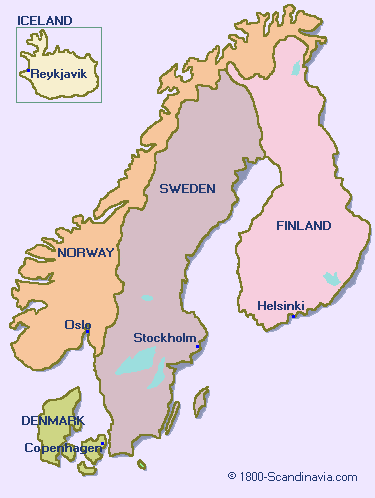
i'd begin by running the tip of my tongue along the coast of sweden, starting at the border with finland and slowly licking up to linger at stockholm. repeat. then i'd swirl past oslo and lower my mouth, gently placing my upper lip against the seaward side of norway and taking both countries into a warm moist kiss. my tongue just can't get enough of stockholm. in my excitment i might just engulf the entire peninsula until my lips land firmly at the base, i mean border of norway, sweden and finland.

i think that's how demark is made, but i can't be sure. we don't learn very much about these things in school.

Monday, February 20, 2006

to gladiate

someone asked me if i am a gladiator, being cheesy i wanted to reply, "no, but i gladiate"...i.e. i like to make people glad...did i really need that i.e.?

anyway, i wanted there to be an etymological relation between gladiator and glad. alas. what you see here is the beginnings of a false etymology. someday i will get a few more degrees and i will spread my false etymologies to the WORLD. or maybe, just maybe, to the moon.

glad
O.E. glaed "bright, shining, joyous," from P.Gmc. *glathaz (cf. O.N. glaor "smooth, bright, glad," O.Fris. gled, Du. glad "slippery," Ger. glatt "smooth"), from PIE *ghledho- "bright, smooth" (cf. L. glaber "smooth, bald," O.C.S. gladuku, Lith. glodus "smooth"), from PIE base *ghlei- "to shine, glitter, glow, be warm" (see gleam). The modern sense is much weaker. Gladden is O.E. gladian "be glad, make glad" + -en. Slang glad rags "one's best clothes" first recorded 1902. Glad hand "the hand of welcome" (often used cynically) is from 1895.

gladiator
1541, from L. gladiator, lit. "swordsman," from gladius "sword," supposedly from Gaul. *kladyos (cf. O.Ir. claideb, Welsh cleddyf, Breton kleze "sword"), from PIE base *qelad- "to strike, beat."

gladiolus
c.1000, from L. gladiolus "wild iris," lit. "small sword," dim. of gladius "sword," so called by Pliny in reference to the plant's sword-shaped leaves. The O.E. form of the word was gladdon.

if we extrapolate!

let's meditate on "slippery," "smooth, bald," "to shine, glitter, glow, be warm" and ease into thinking about the wild iris and the little sword, then let's remember that vagina comes from sheath. [follow that link or face the tiger].

yes. i am a gladiator.

p.s.
glade
"clear, open space in a woods," 1529, perhaps from M.E. glode (c.1300), from O.N. glaor "bright" (see glad). Original meaning would be "bright (because open) space in a wood" (cf. Fr. clairiere "glade," from clair "clear, bright;" Ger. Lichtung "clearing, glade," from Licht "light"). Amer.Eng. sense of "marshy grassland" (e.g. Everglades) first recorded c.1796. this means i waxed.

p.p.s.
ye olde friendster profile once upon a time read:
"Gwendolyn is blended with natural fragrance oils to create uniquely inviting fragrances for your home. Gwendolyn is available in a variety of fragrances that were...Created by Nature. Captured by Gwendolyn."

signs of life?

miracles and tourniquets

i was really struck by the convergence of headlines this morning, especially after thinking all weekend about this image:

let me go home, let me go to him.

if you were trapped under 150 feet of mud, who would you want working up above?

Enthusiasm wanes for people power
MANILA It was 20 years ago this month that Corazon Aquino coined the term "people power" to describe the thrilling popular uprising that drove Ferdinand Marcos from the presidency of the Philippines.

In its iconic image, nuns knelt in the paths of huge tanks as hundreds of thousands of people massed in the streets of Manila with prayers and songs and courage to face down a dictator.


"A new life starts for our country tomorrow," said Aquino, who took office as president when Marcos fled to the United States on Feb. 25, 1986, "a life filled with hope and I believe a life that will be blessed with peace and progress."

It is almost painful to look back today at that moment of celebration and optimism. After two decades of continuing political turmoil - partly fueled by repeated attempts to recreate people power - this nation of political romantics seems to have sunk into a mood of weariness and disillusionment.

A new term has been coined for it: people power fatigue.

"I'm not getting emotionally involved any more," said Sheila Coronel, the country's leading investigative journalist, who was among those who faced the tanks 20 years ago. "It makes me too angry."

"It was miraculous," said an American diplomat who was in the streets during the people power uprising against Marcos. "But you can't live on miracles."

i'd like to believe in miracles, but maybe they only come into play when you've lost your arms and legs and all you've left to live for is to see the person you love one more time before you die. or perhaps they keep you breathing for four days under a mountain of mud. i'm more concerned with what happens when the people with two arms and two legs digging stop believing.

Philippines Rescuers Hear 'Signs of Life'
GUINSAUGON, Philippines - Rescue workers refused to give up hope of finding survivors in an elementary school buried by up to 100 feet of mud, digging into the night Monday after detecting what the provincial governor called "signs of life."

Sounds of scratching and a rhythmic tapping were picked up by seismic sensors and sound-detection gear brought in by U.S. and Malaysian forces.

"To me, that's more than enough reason to smile and be happy," South Leyte Gov. Rosette Lerias said. "The adrenaline is high ... now that we have seen increasing signs of life."

Still, it was hard to imagine survivors under the wet muck nearly four days after a mountainside collapsed and covered the farming village of Guinsaugon, killing up to 1,000 people. No one has been pulled out alive since just a few hours after the disaster Friday morning.
you can read more about the complications associated with arterial tourniquets. you can also make all the anagrams you can out of tourniquet and leave them as a comment.

i have ongoing, growing appreciation for the arcade fire. wake up:
something filled up my heart with nothing, someone told me not to cry. now that i'm older, my heart is colder and i cannot see that it's a lie. children, wake up. if the children don't grow up, our bodies get bigger but our hearts get torn up. i guess we'll just have to adjust.

Tuesday, February 14, 2006

school of love

it has become apparent that i have to learn people today. i hope this makes up for my being so unthankful this past thanksgiving.

so it's valentine's day. if this holiday makes you feel a little crappy, you probably are inclined to complain about its commercial whorery. in which case, isn't this a pretty easy holiday to dismiss? ignore it. it's not like you have the day off of work, or you're supposed to make resolutions, or you have to eat a turkey. even people who do have significant others agree that the greeting cards, flowers and chocolates are ridiculous. this is not a system we have to buck against folks, why let it spoil your mood? also, if you go out and you're alone it screams that you're single and everyone else who is out is also available (like my brilliant red feather idea). this could be good for you.

i'm not even going to write about the history of this holiday [though i recommend you read up on flogging and maybe check out the great romance of the Trumans]. in fact i was almost going to just lie to everyone and insert the history of sweetest day in its place, as that holiday originally attempted to get people to think about those less fortunate and a little outward focus goes a long way on days like this.

i'd be a hypocrite* if i yelled at anyone for being moody, but i can tell you it will hurt my feelings to see you sad and angry today. so let's think outwardly, if need be you can think about me instead of you. it is, afterall, the two week mark to my birthday - february 28.

since, you asked, i am having a GREAT day. my boss brought in dunkin donuts, a lady down the hall gave me some chocolates (really though, the chocolate manufactured for valentine's day - distinguished by its heart shape and red foil packaging - may be made from the waxy substance sucked out of sawdust-stuffed puppets...i think we call those souls.), another coworker became a grandmother at 12:45am, boys on the internet are sending me random messages in spades [won't use that phrase again], my birthday is clearly approaching, i've got a hot date tonight, this woman applying for a scholarship left me a valentine's day voice mail for my customer service, i'm going to alaska in a week. thank you for asking.

your life can be just as good, because i am your friend, and it's likely i will do a little bit more for you than you do in return [with some notable exceptions, you know who you are and i will send you a little card in a few minutes full of rainbows and midi notes - you love rainbows and midi files! i love you].

"There is no remedy for love but to love more."
~Henry David Thoreau

*c.1225, from O.Fr. ypocrisie, from L.L. hypocrisis, from Gk. hypokrisis "acting on the stage, pretense," from hypokrinesthai "play a part, pretend," also "answer," from hypo- "under" + middle voice of krinein "to sift, decide" (see crisis). The sense evolution is from "separate gradually" to "answer" to "answer a fellow actor on stage" to "play a part." Thus hypocrite (c.1225) is ult. Gk. hypokrites "actor on the stage, pretender."

**warning - for mature audiences only. you know the other day someone told me how that infamous duct-tape photo brings out my eyes. it's my opinion that the favorable response to that photo has more to do with the smile under the duct-tape. it would seem unexpected. one time, when i was orally pleasuring a man, he said something that made me want to laugh. i didn't, but i did smile. i would imagine unmistakenly feeling a smile when someone's mouth is on you, is nice. just remember, whenever you can, to smile.

Monday, February 06, 2006

they call us dreamers

they call us dreamers - a pictorial

Bird Ate My Donut showed me this today. Click on the word this before continuing, it is essential to this posting.


1909: On the left is J.T.C. Moore-Brabazon, who earlier the same year was the first British pilot to fly in Britain, in his personal French-built Voisin aero plane. On the right is a pig in a wicker basket behind a sign that says "I am the first pig to fly."


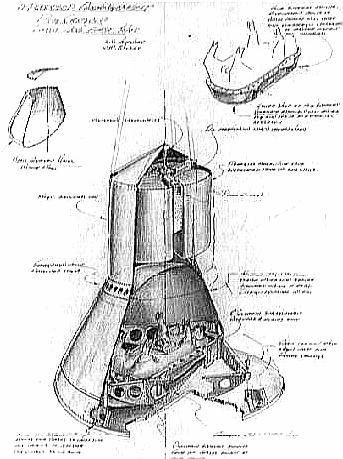
1959: Project, Launch Vehicle Little Joe. Pigs were eliminated as Little Joe flight test subjects when studies disclosed that they could not survive long periods of time on their backs. However, McDonnell did use a pig, 'Gentle Bess,' to test the impact crushable support, and the test was successful.


1983.


Thursday, February 02, 2006

a little birdie

it's time for some updates. i know i want to keep this darn blog merely INFORMATIVE, but i just wanted to tell you a few things and since evidently you lose blog traffic if you don't post often enough. i have to try and keep you coming back.

1) it is thursday, february 2. happy birthday timmy! timmy is that very tall man in idaho who has a new baby girl. also, happy birthday to laurie, don, allie and jon again.

2) i could be seeing andrew bird in milwaukee tonight. that would be great, but it is not happening alas. i have some obligations. i like obligations. and i will go to milwaukee tomorrow night, it is also my sincere wish that andrew bird will not die and i will therefore catch him some time in the future.

3) i will be playing badminton tonight. i need someone with a camera to take a picture of my awesome t-shirt, made by team captain norah. i just went to look up what our standing is after last week - hell yes we're still firmly in second place. raw! a funny bit - when i went to look for my league website - the chicago metropolitan sports association [incidentally, i not only belong to a gay and lesbian badminton league, i belong to the first gay and lesbian badminton league in the country] - i googled "CMSA" and came up with this: www.cowboymountedshooting.com. ooo la la.

4) i'm collecting so much delicious information on whales and squid for my february postings on whales and squids.

5) i will easily compile my 29 things list well in advance of my birthday...

6) i have the technology identified to begin cataloging my books read and movies watched.

7) i have old dreams new again.

Wednesday, January 25, 2006

grasping at fins

good things, like enlarged pelvic muscles and grasping fins in the males of a species, come in small packages. i think when you live in acid and lack a protective head skeleton, you realize what's really important in life.

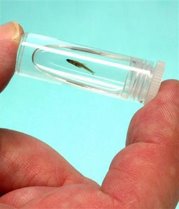
AP Wednesday, 25 January 2006, 06:32 GMT BANGKOK, Thailand - Scientists have discovered the world's smallest fish on record in an acidic peat swamp in Indonesia, with a see-through body and a head that is unprotected by a skeleton, researchers said Wednesday.

Mature females of the Paedocypris progenetica, a member of the carp family, only grow to 7.9 millimeters (0.31 inches) and the males have enlarged pelvic fins and exceptionally large muscles that may be used to grasp the females during copulation, researchers wrote in the Proceedings of the Royal Society, published Wednesday by the Royal Society in London.

"This is one of the strangest fish that I've seen in my whole career,' said Ralf Britz, zoologist at the Natural History Museum in London, who helped analyze the fish's skeleton. "It's tiny, it lives in acid and it has these bizarre grasping fins. I hope we'll have time to find out more about them before their habitat disappears completely."


The previous record for small size, according to the Natural History Museum in London, was held by an 8-millimeter species of Indo-Pacific goby.

The new fish was discovered on Sumatra island by fish experts Maurice Kottelat from Switzerland and Tan Heok Hui from the Raffles Museum of Biodiversity Research in Singapore. They were working with colleagues from Indonesia and with Kai-Erik Witte from the Max Planck Institute in Germany.

"You don't wake up in the morning and think today we will find the smallest fish in the world," Kottelat told The Associated Press in a telephone interview from his home in Switzerland.

He said the record of finding the world's smallest fish was not important, preferring to focus on what he said was "scientifically significant."

"What's important is finding a complete vertebrae in a body so small," he said.

Kottelat said he first came across the fish in 1996, but originally misidentified it as a member of an already existing species. "But then we realized this one was different."

According to the researchers, the fish live in dark, tea-colored water with an acidity of ph 3, at least 100 times more acidic than rainwater. Swamps like this were once thought to harbor very few animals, but recent research has revealed that they are highly diverse and home to many species that occur nowhere else.

Peat swamps are under threat in Indonesia from fires lit by plantation owners and farmers as well as unchecked development and farming. Several populations of Paedocypris have already been lost, researchers say, according to the Natural History Museum.

Associated Press writer Bradley S. Klapper in Geneva contributed to this report


possible segues: size does matter...; in other news...; are there plenty of fish in the sea...; the dangers of holding on loosely...

BBC Tuesday, 17 January 2006, 14:38 GMT
By Richard Black

Environment Correspondent, BBC News website, Darwin


Whale sharks spotted off the coast of Australia are getting smaller, researchers have said.


In a decade the average size recorded by observers has shrunk from 7m to 5m.

Whale sharks, the world's largest fish, are caught for food in some east Asian countries and Australian researchers suspect this is causing a decline.

"Now, if you consider that the sharks probably aren't sexually reproductive or mature until they're 6 or 7m long - that's a very worrying sign."

Whale sharks (Rhincodon typus) are filter feeders, eating small marine organisms such as krill.

They can live for up to 150 years, attaining lengths of more than 15m, and are believed to reach sexual maturity around the age of 30.

Under the IUCN Red List of threatened species, they are categorised as "vulnerable" to extinction.

"Whale sharks, like many other shark species, are highly vulnerable to over-exploitation due to their long lifespan and low reproductive rate," commented Callum Roberts, of York University in the UK, who has researched whale sharks extensively in the Caribbean.

Finding migration routes could help pinpoint areas where they are being caught.

"Many of the people doing the fishing are just local villagers with no other option," said Mark Meekan.

Longer term objectives of the Aims programme include finding out more about the life cycle of the whale shark.

The biggest mystery concerns breeding and reproduction; males and females live in largely segregated communities, but must come together somewhere to breed.

Saturday, January 14, 2006

patent your brain

or face the realization that your brain could also belong to some dude that's from berkeley and who sports a ponytail.

consider yourself warned!

nick has my brain.

Passion and Etymology

Disclaimer: I seem to be kind of harsh on linguistics lately. Please don’t think I have anything special against it, or against linguist bloggers. Some of my best friends, as the saying goes, are linguists who blog, and I adore Language Log. But….

Arnold Zwicky at Language Log has an interesting post on the “etymological fallacy.” It involves a quotation in which someone talks about the historical connection between passion and suffering (in the context of encouraging people to differentiate what you’re passionate about from what you like):

This does not mean that pursuing a mission is always pleasurable: we do not agree with the pop psychology view that equates meaningful work with fun. Indeed, the etymological root of ‘passion’ is passe – or ‘to suffer.’ We are aware that pursuing a noble mission is often painful…

Zwicky replies:

The noun stem passio:n- originally would have meant ‘suffering’, and indeed passion is still used in this sense in the very specialized context of the sufferings of Jesus (The Passion of the Christ, passion play, etc.). But early on—the OED Online draft revision of 2005 lays out these changes in some detail—it developed not only an ‘undergoing’ sense (‘fact or condition of being acted upon’) parallel to that of patient and passive, a sense that seems to have gone out of fashion some 500 years ago, but also a separate extended sense, a generalization from experiencing pain to experiencing any sort of intense feeling or emotion, especially love or sexual desire (_His voice was husky with passion_), or, in another direction, enthusiasm or zeal (_a passion for astrology_), or, in still another direction, anger or rage (_a fit of passion_).

The result of all this semantic radiation, generalization, and specialization is that modern English passion has a variety of senses—among them, love or desire, enthusiasm or zeal, and anger or rage (all attested from the 16th century on)—that are not directly connected to one another and have nothing in particular to do with suffering.

Now, let’s begin by granting that we shouldn’t all suddenly stop using “passion” the way we did yesterday. It still gets to mean infatuation, and so forth, and it still gets to be used in “passion play,” and we don’t have to find a way for those two usages to be identical. This is what I take Zwicky to mean by “not directly connected.” But should we also suppose that there is no continuing interaction between these different meanings of the word? I don’t know about you, gentle reader, but understanding a tiny smidge about, say, early Christianity, has had a non-trivial impact on the way I use the word, the way I think about it, and the situations in which I would apply it, and I’m willing to guess I’m not the only person writing in the English language today for whom this is true. In that case, there’s really nothing at all wrong with someone pointing out that there’s a difference between passion and liking, or, even, referencing the etymology in the process.

Of course, one could come back with a claim that we’re all laboring under an etymological fallacy, and this is quite possibly the case, but it’s also a reality of how we really use the word. (And don’t we all know by now that wishful prescriptivism about how to use words in the face of how people really use words is a bad, bad thing perpetrated by bad, bad people? There’s a hole in my reasoning here, I know, and I’ll get back to you on that.)

There’s also, perhaps, a point to be made regarding the original expansion in meaning. Zwicky calls it “a generalization from experiencing pain to experiencing any sort of intense feeling or emotion,” which I’m sure is true, but I had the impression—and feel free to heap invective on me via comment or email if I’m wrong here, as my classical education is almost as inadequate as my linguistics education—that there was also an implicit connection, in the context of ancient psychology, between intensity itself and suffering—that at the heart of romantic love and other “passions” is already a kind of suffering or dis-ease. And even if I’m not historically grounded here, I think we can do some perennialist psychology and just say there really is such a connection, trans-historically, biotch. To quote Roy Orbison:


Love hurts
Love scars
Love wounds and mars
Any heart not tough
Or strong enough

To take a lot of pain
Take a lot of pain

If this is so, and if there was some intuitive connection at work in the original process by which “passion” acquired new meanings, what’s wrong with reminding people of the historical connection?

Note: To return to that earlier hole (orig. “whole”—Nicklexia strikes again) in my reasoning, I was conflating “possibly spurious claims regarding historical linguistics” with “usage”, i.e., suggesting that when someone makes a claim about, say, the meaning of a word, their claim is itself a real linguistic phenomenon which descriptivists are honor-bound to take seriously as such. In doing so, I probably overstate my case somewhat. Attacks by linguists on false or misapplied etymologies are more on the nature of sometimes excessive, sometimes justified, fact-checking by specialists.

But, in this case, it’s a little different from, say, bitching about how you can hear TIE fighters go by in Star Wars, where the obvious response is, “Yes, you’re right, but lighten up, man, it’s a space opera.” (Note: I’ve been on either side of that one plenty of times, so don’t think I’m innocent of nitpicking.) Or, more linguistically, the recent rant in Languagehat on NYT’s bad instruction on the pronunciation of “quipu,” which is wholly justified.

But spurious etymologies really are, sometimes, really part of how people really use language; it would obviously be insane to say either that (a) we must all use only correct etymologies, or (b) we must all never talk about etymology again. The etymological fallacy is, in a certain sense, just another linguistic phenomenon, even though it’s also an intrusion on the hallowed ground of linguistical expertise. Anyone who’s engaged in any kind of study of religion is familiar with the proliferation of spurious etymologies and place- and personal name etiologies; we don’t have records of language that go back too much farther than the sacred (and wildly unsound, etymology-wise) texts of the Judeo-Christian and Hindo-Buddhist worlds, (which were typically composed by the best-educated and most historically conscious members of their communities) so, while it may or may not be the case that “The persistence of the Etymological Fallacy among intellectuals is in some ways deeply puzzling,” it’s certainly not in the least surprising, and to say otherwise is to demonstrate a certain disregard for the history of intellectuals and ideas, as well as writing and, probably, speaking.

And while it’s become fashionable in some circles, especially on the internet, to bash the somewhat loose way of religious teachings with facts (obviously I’m not talking about Language Log here), the practice of enriching language with meaning through creative historical linguistics is probably indispensable to many sacred paths, and I would be hard-pressed to reject those paths, or the vitally important contributions they’ve made to human thought…(Though certainly I’ve been known to say some unkind things about translations of the Vajracchedika, known as the “Diamond Sutra” throughout much of history, including the present.)

p.s. i didn't want to edit all of that so there's a lot of hyperlinks missing from nick's post. go follow the link already.

Wednesday, January 11, 2006

29 things

my birthday is coming up. i will be turning 29 on february 28th. last year was my golden birthday. to gear up, i've decided to compile 29 things about me in the more than 29 days between now and then. it's like 43things or allconsuming, but actually it will be exactly different. i won't put any links in my list. the buck will stop here, once i begin here that is. right now, we're still in the prologue so i can send you there.

content (v.) Look up content at Dictionary.com
1418, from M.Fr. contenter, from content (adj.), c.1400, from L. contentus "contained, satisfied," pp. of continere (see contain). Sense evolved through "contained," "restrained," to "satisfied," as the contented person's desires are bound by what he or she already has.

29 things

1. my sun sign is pisces. i've recently decided to never ever again read my horoscope as it's slowly transformed to something that invokes dread. i'm presently experiencing a deep need to feel as if all things are less pivotal. that said, i think i'm going to be blogging a lot about ocean creatures in the month between now and my birthday.

Sunday, January 08, 2006

wordlets

twice in as many days, i've noticed my mind mashing words. namely:

"still talk" > stalk
"shallow wallow" > swallow

that's about all.

i did go try to look up the etymology of the word shallow. i didn't find anything exciting but i did for some reason hit upon this list of standard english words which have a scandinavian origin [remember to track my ongoing scour of scandinavia]. you can view the full list at http://www.viking.no/e/england/e-viking_words_2.htm, and let me thank scandinavia in general for these:

Abbreviations: E = English. ME = Middle English. SE = Standard English. Ice = Icelandic. Swe = Swedish. O Swe = Old Swedish. Dan = Danish. Nor = Norwegian. Scan = Scandinavian (in general). Fr = French. Du = Dutch. vb = verb. n = noun. adj = adjective. advb = adverb.

balderdash (n) Poor stuff. Scan. Originally meant a poor or weak drink. Dan balder (noise, clatter) dask (to slap, flap). Compare with E slap-dash.

brunt (n) Shock of an onset. Scan => ME brunt (an attack). Ice bruna (to advance with the speed of fire, as in battle) from Ice bruni (burning, heat). To 'bear the brunt of something' is used in contemporary E with the meaning 'to take the main weight (or first shock) of some occurrence or action'.

cock (n) A pile of hay. Dan kok (a heap), Ice kökkr (lump, ball), Swe koka (clod of earth).

dairy (n) Scan => ME deyerye (a room for a deye, i.e., a milk-woman or farm servant). Ice deigja, Swe deja (a maid, dairymaid who was also a bread-maker. The original sense is 'kneader of dough').

freckle (n) A small spot of skin colouring. Ice freknur, Swe fräkne, Dan fregne (a freckle).

froth (n, vb) Foam on liquids. Scan => ME frothe. Ice froða, Dan fraade, Swe fradga.

dastard (n) Scan => ME dastard, where -ard is a Fr suffix. Ice dæstr (exhausted, weary). The original sense of the word is sluggard.

kidney (n) Scan. Corruption of the ME kidnere, kidneer. Ice kviðr (womb), Swe qved (womb) anotomically inappropriately combined with Ice nýra, Dan nyre, Swe njure (a kidney).

muck (n, vb) Filth, dirt. Ice myki (dung), Dan mög (dung). Dialectal in E but has now passed into SE usage. The verb form 'to muck (about)' means to behave irresponsible, to mess with things; the associated adjective is mucky.

pap (n) A teat, a breast. O Swe papp (the breast), changed in modern Swe to patt. Also Swe dialect pappe. Associated with E pap (an infant's soft food).

quandary (n) An evil plight. Ice vandræði (difficulty, trouble), O Swe wandräde (difficulty).

rigmarole (n) Scan and Fr-Latin. A corruption of ragman-roll, originally meaning a deed with many signatures, a long list of names, and hence a long, stupid story. Literally 'a cowards' roll'. Ice ragmenni (a coward) roll (list).

rump (n) Ice rumpr, Swe rumpa, Dan rumpe. Originally meant the bulk of the body without the head but now in SE indicates the buttocks, the 'rear-end' of a person.

thrust (n, vb) Ice þrýsta (to thrust, press, compel). Allied to the SE threat/threaten.

thwart (n, vb) Transverseley, transverse. Ice þvert (adverse), Dan tvær (transverse), Swe tvär (across). As a noun in E it is used mainly of transverse panels across a ship or boat, including seats, with the associated maritime term 'athwart' standing for 'across'. In its original maritime usage it probably indicated a part of a ship's architecture which prevented (thwarted) the ingress of water or the movement of cargo. The SE verb 'to thwart…something' means to prevent something happening or put some obstacle in the way, as in 'they thwarted his plan to become president'.

trist, tryst (n) An appointment to meet. Scan. Properly, a pledge. From traust (see trust).

want (n) Lack, deficiency. Scan => ME want. First used as an adjective signifying 'deficient'. Compare with Yorkshire dialect usage of a verb form in, for instance, 'the grass wants cutting', where 'want' stands for 'needs' or 'requires', whereas the SE would be 'the grass needs (or requires) cutting'.

whim (n) A freak. Ice hvima (to wander with the eyes, as of a silly person), Nor kvima (to whisk about, to trifle). Compare Swe dialect hvimmerkantig (giddy in the head) allied to Nor kvimsa, Swe dialect hvimsa, Dan vimse (To be giddy, to skip about). In modern SE the meaning is a sudden desire or notion to do something without a great deal of thought, as in 'she did it on a whim'.

Thursday, January 05, 2006

rock the cock

did you know i joined a badminton league? i did. it's through cmsa, i am now joining the chicago lesbigay community. HELL YEAH.

time for me to shine. really shine. like a bright star.


thanks, evan, for the totally rad e-card. now show me your bandy tits!

Thursday, December 29, 2005

scandalous scandinavia

i'll admit it, i'm presently obsessed with vikings. subsequently, i've been reading up on scandinavia. yesterday, i was strangely fascinated when i noticed that scandinavia's wiki was under dispute. mini-modern-marauding? i felt i had to share this news, spread a bit of passionate interest in information to the world, and so i told um maybe three people to go look at the page. wouldn't you know it, the very next day they settled the dispute and removed the under-dispute tag on the wiki. i seem to be an agent of peace and accord, but you can review the history of this small war on the talk page.

even more moving than the heated debate on finland, was my complete revelation that scandinavia is unarguably shaped like a penis.

Wednesday, December 28, 2005

Tuesday, December 27, 2005

rebus loves me this i know

i went to sea in search of vikings

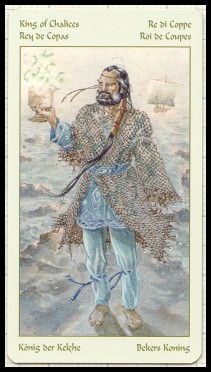
King of Chalices ~ The Fey Tarot
"With maturity, emotions do not vanish but become more removed and deeper. Just as waves in the sea are more difficult to see** when the sea is deep, so are the great emotions of the king. They run deep but envelope every fibre in his body."


sans maturity, that seems to be more of the same*. perhaps i should set my sights higher.

mountain men?


*"Originating in the 1830s, hunting dogs in the United States were often fooled when chasing after small animals like raccoons. The small creatures would climb up one tree, then jump to another...leaving the hound to mislead his master into thinking they were in the right place." it appears that barking up the wrong tree is a truly american slang, only in the united states are our dogs this easily confused?

**"Please slow it down/There’s a secret magic password/That you only notice when you’re looking back at it/And all I wanna do is turn around/I'm going down to sleep on the bottom of the ocean/Cause I couldn’t let go of the water at the setting sun/Cause I couldn’t let go of the passing moment gone." white daisy passing, rocky votolato.

Saturday, December 03, 2005

the bees knees

bees do not have knees. go look up that expression for me, gentle reader. share it with others via a comment.

i am eating hot chocolate so-called because it is supposed to be hot and it is a chocolate bar. it's nothing compared to some chili chocolate i brought home from montreal. i want that chocolate--chocolate so hot i could only take one small bite a sitting, and i needed to drink water. that's the kind of chocolate that burns one into feeling they have a heart still.

i'm listening to my favorite artist, ill lit, right now. i must share my favorite words. now.

and you've got your endurance, make sure that it's working.
stay a little longer, show her you're worth it.
the list of understandings and
arguments is inside.
well, every hip girl i know these days likes
suicide.

i was beat with an elder stick, crooking my neck but i grew it thick.
there's always fog at this height.
with all the ghosts you swear
you need the ones condemning who you'll be. i'll be the one setting them
free but you can't tell them from me.

break yourself, it won't hurt a bit.
even always cold, you're never used to it.
and all the weather's for you to help you adore her.

i miss your understanding.
and all we have is this time.
you told me everything
that i believe will save me tonight.

i can't think of a line ... except maybe that andrew bird one ... that hits me harder than "break yourself, it won't hurt a bit". i am not sure why, it doesn't seem that complicated nor half as pretty as the elder stick lyric, another favourite. but i guess i want more people to break themselves.